What is solar panel cleaning?
Solar panel cleaning removes the layers of dirt, dust, pollen, bird droppings, and snow that accumulate on photovoltaic modules and block sunlight from reaching the cells. The industry refers to this buildup as "soiling." According to a 2025 International Energy Agency (IEA) fact sheet, soiling reduces global solar energy production by 4% to 7%, costing billions of euros annually. The heaviest losses occur in dusty equatorial zones and snowy high-latitude regions.
By restoring a clear glass surface, cleaning brings a plant's output back to its maximum potential. While manual washing with water and brushes is still common, operators must carefully balance the schedule: cleaning too rarely sacrifices energy, while cleaning too often wastes money and water. The timing is calculated directly against the value of the energy recovered.
The process isn't without risk. Brushes slowly wear down the glass and its anti-reflective coating, and certain harsh chemical agents can cause permanent damage. In fact, a German photovoltaic institute recorded output losses of up to 5.6% after soaking module glass in commercial cleaners. Because of this, facility owners closely monitor brush materials, water quality, and chemical use.
Who relies on solar panel cleaning?
-
Utility-scale plant owners: For sprawling solar farms, lost output equals lost revenue. Operators schedule cleanings based on local soiling rates and current energy prices to maximize profitability.
-
Operations and maintenance (O&M) contractors: Tasked with maintaining plant performance under long-term contracts, these teams own or rent specialized equipment and must efficiently cover massive surface areas with minimal manpower.
-
Commercial and industrial property operators: Managing smaller arrays on the flat or slightly sloped roofs of warehouses and factories, these operators face unique logistical and safety challenges associated with elevated, edge-of-roof work.
-
Dedicated solar cleaning services: These mobile businesses contract with the groups above. Their profit margins rely heavily on speed, efficiency, and having equipment compact enough to fit in a standard van.
How robots clean solar panels
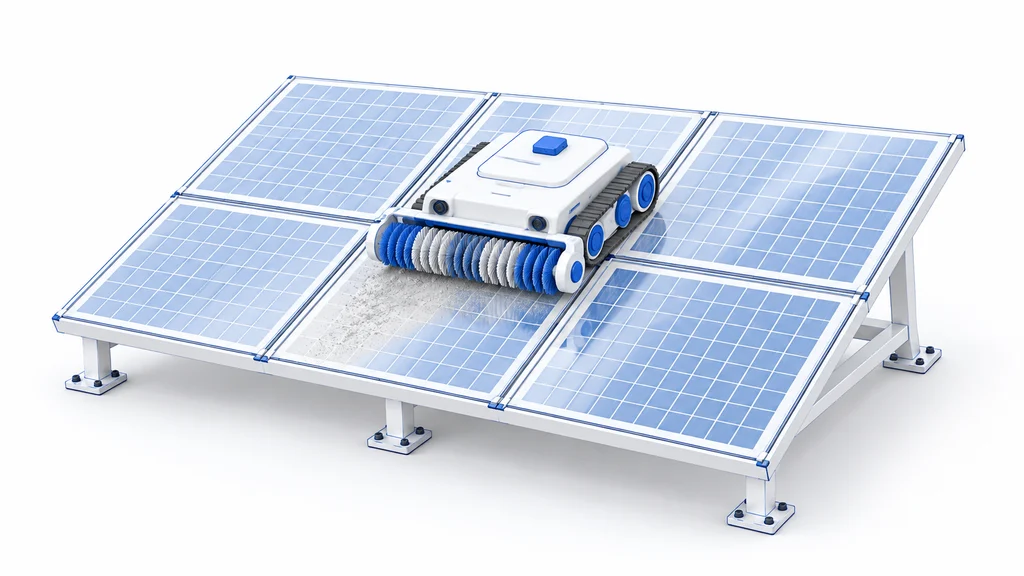
Most solar cleaning robots mount directly onto the panels, driving along the rows while a rotating nylon brush sweeps away debris without scratching the glass. These machines can operate dry or wet. Dry cleaning allows the robot to work entirely autonomously, while wet cleaning—which helps loosen stubborn dirt—requires about 1.3 to 1.6 gallons of water per minute, meaning a human operator usually has to manage a hose on simpler models.
Ultrasonic cameras and edge sensors keep the robots from falling, while slope locks secure them on tilted arrays (functioning up to a 25-degree incline wet, or 33 degrees dry). Advanced models feature tracks that can easily bridge two-inch gaps between modules, though gaps over 16 inches or row changes still require a human to manually lift and reposition the machine.
Control systems range from basic live-video remotes to fully autonomous AI that maps the array, cleans it, and returns to base. Depending on the model, a single robot can clean between 9,700 and 21,500 square feet per hour, run for 4 to 10 hours per charge, and withstand moderate rain (up to 2 inches an hour) and wind (up to 24 mph).
Not all automated cleaners ride on the glass. Some ground vehicles drive alongside large arrays, extending a cleaning arm over the panels to safely wash both fixed and tracking rows, handling up to 5 megawatts of capacity in a 6-to-8-hour shift. Alternatively, specialized drones can fly over the array, spraying panels with a water jet from an onboard 2.6-gallon tank or a tethered ground hose—though their flight times are currently limited to about 16 minutes per tank.


