
Glossary
Definitions and classification terms used throughout Machine Census.
/00
Browse by topic
/01
Core definitions
The entities that form the foundation of Machine Census.
- Robot
- A physically embodied machine that senses its environment, determines an action through software, control logic, an operator, or a combination of these, and acts in the physical world to perform a defined task.
- Maker
- An organization or team responsible for developing a robot. A maker may be a company, business unit, research lab, nonprofit, open-source project, or independent team.
- Supplier
- An organization or team offering a product used to build, operate, or improve robots, with robotics as an explicit target market or use case.
- Deployment
- A named operator has the robot doing real work at a site where it operates, whether that work is a trial or part of normal operations. The census records no separate pilot: the press uses both words for the same fact.
/02
Embodiment types
The physical forms most often used to describe a robot. A robot can belong to more than one embodiment type.
- Manipulator
- A robot arm or other mechanism for interacting with objects. A stationary manipulator is attached to a fixed base or workcell; a mobile manipulator combines one or more arms with a mobile base.
- Humanoid
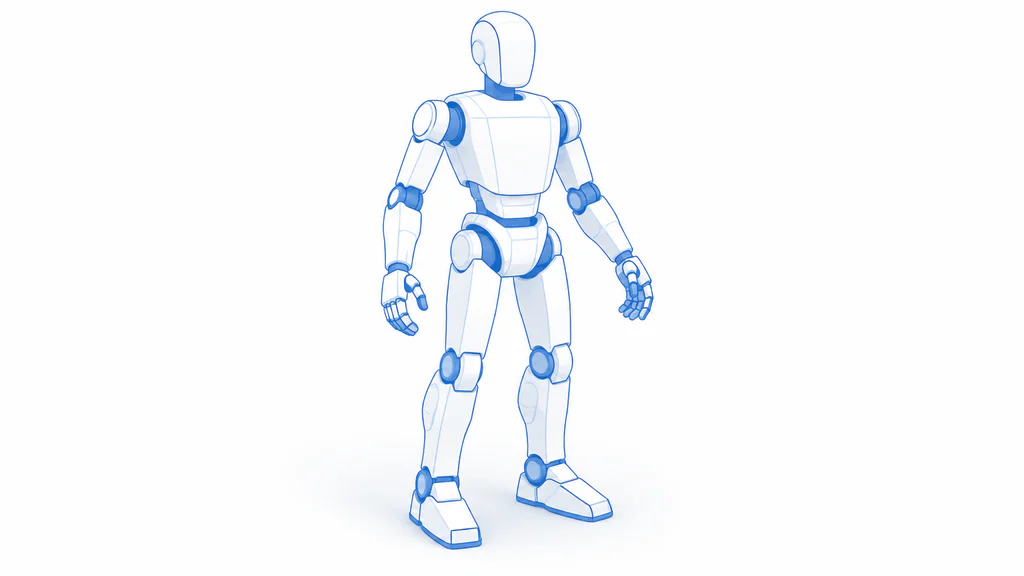
- A robot whose body plan is substantially modeled on the human form, typically with a torso, head, arms, and two legs. Human-like appearance alone is not sufficient.
- Autonomous mobile robot (AMR)
- A wheeled platform that moves goods or equipment through a shared workspace, navigating around obstacles on its own, common in warehouses, factories, and hospitals.
- Tugger
- A wheeled robot built to pull carts, trailers, or a train of carts through a hitch or coupling, commonly called a tow tractor or towing robot. The load stays on the towed carts rather than being carried on the robot or lifted on forks.
- Forklift
- A wheeled robot with forks that enter beneath a pallet or other load, support its weight from below, and raise it on a mast or other lifting structure for stacking or placement on racks. Includes counterbalanced forklifts, reach trucks, and pallet stackers. A tall mast, high picking reach, or a mechanism called a fork does not by itself qualify a case-handling robot that grips or pulls containers onto storage trays. Excludes pallet jacks built mainly for horizontal pallet transport.
- Pallet jack
- A wheeled robot with forks that enter beneath a pallet and lift it for horizontal transport, commonly called an autonomous or automated pallet jack or pallet truck. It raises pallets mainly to clear the floor or transfer them onto low supports, rather than to stack them or place them on racks.
- Uncrewed ground vehicle (UGV)
- A wheeled or tracked vehicle that works on ground terrain, remotely operated or under its own control, common in defense, security, inspection, and field work.
- Pipe crawler
- A wheeled or tracked robot that drives itself along the inside of a pipe, sewer, duct, or other conduit, commonly called a pipe crawler, pipe robot, or in-pipe robot. It is usually lowered in through a manhole or access port and steered over a tether that also carries power and video. Includes crawlers that carry cameras, sensors, cutters, or joint-sealing tools; the tool head does not add manipulator. Excludes push cameras and rods fed through the pipe by hand, and floats or sleds pulled through the pipe without a drive of their own.
- Climbing robot
- A robot that holds itself to a vertical, overhead, or curved surface with magnets, suction, or another adhesion mechanism and moves across it on wheels, tracks, or legs, commonly called a climbing robot, wall-climbing robot, or magnetic crawler. It works on ship hulls, storage tanks, towers, blades, and glass facades, in air or under water; the adhesion decides the form even when it walks on legs. Excludes robots that climb storage racks or stairs by the shape of the structure, and pipe crawlers that brace against the inside of a pipe.
- Uncrewed aerial vehicle (UAV)
- An uncrewed aircraft, commonly called a drone, either remotely piloted or under its own control, whether an airplane, helicopter, quadcopter, or another airframe.
- Quadcopter
- An uncrewed aircraft lifted by exactly four rotors on arms around a central body, commonly called a quadcopter or quadrotor drone. It takes off, lands, and hovers vertically. Excludes aircraft with six or more rotors and aircraft with a wing.
- Hexacopter
- An uncrewed aircraft lifted by exactly six rotors on arms around a central body, commonly called a hexacopter. It takes off, lands, and hovers vertically. Excludes quadcopters, octocopters, and aircraft with a wing.
- Helicopter
- An uncrewed aircraft lifted by one main rotor, with a tail rotor or a second coaxial rotor to counter its torque, commonly called an unmanned helicopter or helicopter drone. Excludes multirotor aircraft with rotors on arms around the body.
- Fixed-wing
- An uncrewed airplane that gets lift from a fixed wing and must keep flying forward to stay aloft, commonly called a fixed-wing drone or drone plane. It launches from a runway, a catapult, or by hand and cannot hover. Excludes hybrid aircraft that add lift rotors for vertical take-off and landing.
/03
End-user segments
Who a robot is intended for or documented as serving. A robot may have several segments when its official page supports distinct audiences or uses. Classify the user's role and purpose; research takes priority for the same use, and ownership alone does not determine the segment.
- Enterprise
- Intended for or used by a business or institution for production, service delivery, or routine operations. Includes service providers, nonprofit organizations, and self-employed professionals. Public hospitals, universities, and state-owned companies belong here when the robot serves routine operations rather than research or a government function.
- Government
- Intended for or used by a public authority to perform a government function, such as defense, policing, emergency response, or civil administration. Public ownership alone does not qualify. Research use belongs to Research.
- Consumer
- Intended for or used by an individual or household for home or personal activities, such as cleaning, assistance, companionship, entertainment, or learning. Business use belongs to Enterprise, even when the robot is owned by an individual.
- Research
- Intended for or used primarily as a platform for scientific research or experiments by a university, laboratory, company, or public body. Research use takes priority over the operator's organization type. Routine operations at a research institution, classroom teaching alone, and a maker's testing of its own product do not qualify.
/04
How the glossary is used
This glossary explains what Machine Census terms mean. The separate listing policy explains when a robot, maker, supplier, or project qualifies for inclusion.
Definitions will evolve as the census grows. If you believe a term or classification needs correction, send us the relevant evidence.