What is commercial window cleaning?
Commercial window cleaning removes dirt and grime from the exterior glass of offices, hotels, hospitals, schools, and apartment towers, typically on a recurring seasonal or annual schedule. In the United States, it is a $2.9 billion industry powered by roughly 35,000 predominantly small businesses, with commercial properties generating the vast majority of the work.
The primary challenge isn't washing the glass—it's reaching it. For low- to mid-rise structures (up to eight stories), crews rely on water-fed telescopic poles and boom lifts. These systems pump tap water filtered via reverse osmosis and deionization (reducing dissolved solids to under 10 parts per million), allowing the glass to dry completely spot-free without manual squeegee work. For high-rises exceeding these heights, workers must use specialized rope descent systems, suspended swing stages, or building maintenance units (BMUs) integrated into the roof.
Height introduces strict safety standards and operational hurdles. Federal regulations cap rope descent at 300 feet, requiring building owners to provide written certification that every anchor point can withstand at least 5,000 pounds per worker. Heavy ground equipment can block sidewalks and building entrances, and because manual methods become exponentially slower with every additional floor, labor costs scale rapidly with height.
Who relies on commercial window cleaning?
-
Office and mixed-use property managers: Overseeing high-rise towers, these managers maintain strict cleaning schedules to keep tenants happy while ensuring all rigging complies with certified building anchor and BMU safety standards.
-
Hotels, healthcare facilities, and university campuses: Operating around the clock, these facilities cannot afford blocked entrances, valet delays, or patient disruption, driving demand for unobtrusive cleaning methods that eliminate heavy ground machinery.
-
Retail and low-rise commercial operators: Storefronts and suburban office parks prioritize high-frequency, budget-friendly cleaning, typically outsourcing the work to route-based pole-cleaning contractors.
-
Residential property managers: Managing multi-family and condominium towers with hundreds of individual windows and balconies, these operators split access equipment costs across HOA or building maintenance budgets.
-
Window cleaning contractors: Operating as the primary service providers, these companies invest in purifiers, poles, lifts, and safety gear, training certified crews whose efficiency directly drives profit margins.
How robots clean commercial windows
Spraying drones
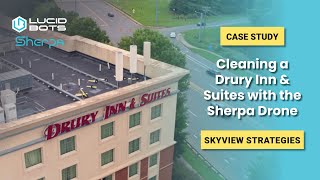
Drones hover a few feet from the building facade, rinsing glass with purified water and mild detergents. Water is supplied either via a ground-based hose and pump system or an onboard 2.6-gallon tank (providing roughly 16 minutes of flight time). While high-pressure pumps deliver up to 11 gallons per minute at 4,000 PSI, the water is applied at low pressure to safely rinse away surface dirt without damaging seals. Battery-powered drones operate up to 195 feet high, while tethered systems can reach up to 490 feet. Because drones do not physically contact the glass, they are best suited for routine maintenance rather than heavy restoration scrubbing.
From an operational standpoint, a FAA Part 107 certified pilot and a ground assistant can replace a traditional four-to-six-person rope crew. While flights over active pedestrian zones require FAA waivers and temporary sidewalk closures, ground entrances remain open and accessible. However, operation remains strictly dependent on clear weather, as high winds and rain force immediate grounding.
Cradle-mounted arm robots
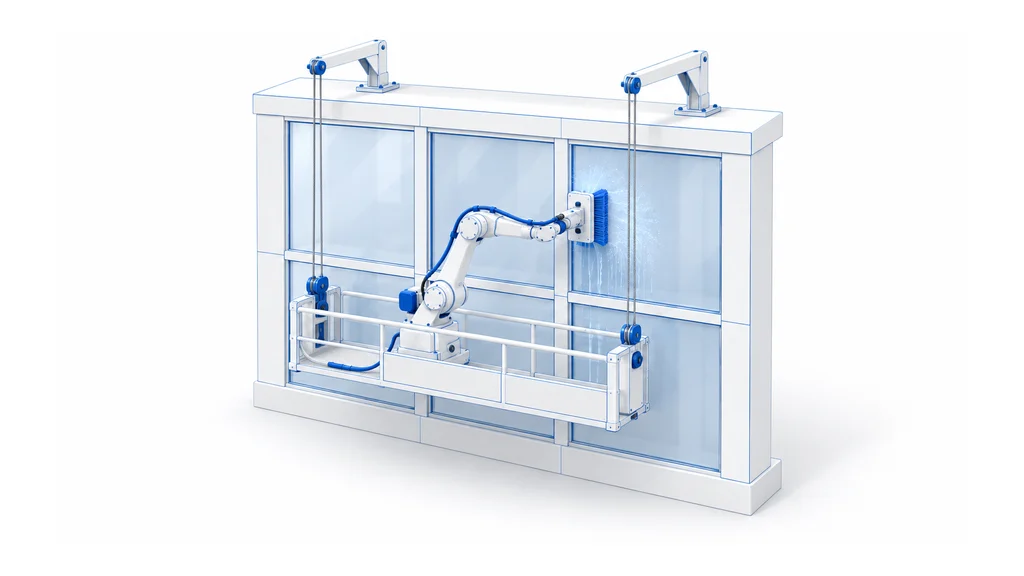
Designed for high-rise towers with existing building maintenance units (BMUs), these systems replace the human basket crew with a six-axis robotic arm mounted directly to the roof cradle. Using LiDAR facade-mapping, camera vision, and real-time force sensors, the arm adjusts brush pressure and sprays purified water, recalculating its cleaning path over 200 times per second to compensate for cradle sway.
While initial setup takes 90 minutes to 2.5 hours, the system reduces labor demands down to a single supervisor on the roof. Manufacturers report these automated arms can clean glass up to three times faster than traditional human crews.