What is pipe inspection?
Pipe inspection is the process of recording and analyzing the internal condition of buried pipelines. While the specific objectives vary depending on the type of utility line, the overarching goal is to identify defects, assess structural integrity, and prioritize repairs before catastrophic failures occur.
From a standard sewer survey, the utility owner receives a continuous video of the pipe's entire length. The video is metered from the starting manhole so every frame displays its exact distance. Observations are logged using standardized defect codes and graded on a severity scale (typically 1 to 5). These grades calculate a comprehensive condition rating which, when weighed against the potential cost of failure, dictates the repair schedule.
Accessing the interior of a working pipeline is logistically challenging. Crews typically enter through manholes that can be hundreds of feet apart, feeding equipment into lines as narrow as 8 inches. Because sewers remain active, flow must be controlled or pipes cleaned prior to the survey. Confined space entry poses severe risks—including hydrogen sulfide gas and low oxygen levels—requiring strict safety protocols, specialized permits, air monitors, and standby rescue plans.
Gas and water mains present their own challenges, as surveys are often conducted on live, pressurized lines to ensure homes and businesses do not lose service during the inspection.
Who relies on pipe inspection?
- Sewer Utilities: These municipalities or companies own and maintain wastewater networks. They mandate standardized defect coding so a unified rating method applies system-wide. Some operate their own camera trucks, while others contract the work out.
- Water Utilities: Operators of pressurized drinking water networks rely on internal pipeline data to perform targeted repairs or replacements before major leaks or ruptures happen.
- Gas Distribution Operators: Bound by federal regulations to understand system threats (such as corrosion and excavation damage), these operators use internal main inspections to provide critical data for their mandated risk assessments.
- Pipe Inspection Contractors: These specialized vendors provide the crews, trucks, and equipment, typically bidding on unit prices for labor and materials. Their camera operators are required to hold current certifications in regional or national coding standards.
- Real Estate Developers: When building new infrastructure, developers must hire approved vendors to film newly laid sewers. The utility will not adopt the line—and surface paving cannot proceed—until the video proves the pipe is free of construction defects.
How pipe inspection robots work
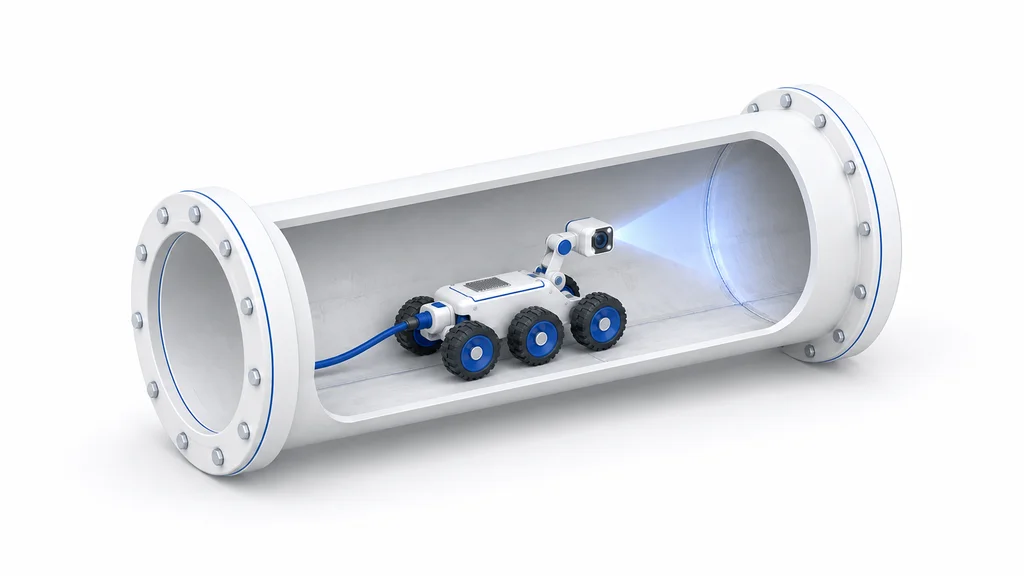
The most common tool for this work is a tethered camera crawler. The crawler drives through the pipe powered by a cable that also transmits video and data back to the surface, utilizing reels that can hold up to 2,000 feet of line.
To navigate varying environments, crews customize the crawler's chassis. Options include six-wheel drives for climbing over pipe offsets, cleated tracks for gripping past protruding service connections, or large pneumatic tires for traversing deep mud and sand. Operators manually drive these crawlers at a maximum speed of 30 feet per minute—slow enough to spot minute damage, leaks, and deposits.
Cameras and Lasers
The crawler's camera features pan, tilt, and zoom capabilities, operating under onboard lighting. Real-time distance counters are overlaid on the video feed. Advanced crawlers also carry laser calipers to measure crack widths and built-in inclinometers to plot the physical grade of the pipe.
Navigating Flooded Sections
Because optical cameras cannot see through murky wastewater, crawlers are often equipped with sonar heads. The sonar emits sound pulses to map the pipe's underwater cross-section, revealing silt, debris, and hidden wall irregularities. In large conduits (up to 240 inches in diameter), floating or rolling platforms combine lasers, sonar, and cameras to generate a complete 3D model of the pipe.
Autonomous and Lateral Robots
Small, untethered robots can be dropped into 8- to 12-inch sewers to autonomously record video before returning to the manhole. For inspecting branch lines, "lateral launch" systems use a mainline crawler to push a secondary, flexible camera up to 150 feet into residential service connections.
Non-Destructive Testing (NDT)
Rather than just capturing video, specialized robots measure material integrity. In live gas mains, these robots enter through a small excavation (without venting gas) to measure wall thickness over 1,000 feet of cast iron. In water mains, tracked robots use specialized sensors to read metal loss through internal deposits up to 1.25 inches thick. Regardless of the technology used, human operators are typically still required to formally code the observations.


