What is crop spraying?
Crop spraying is the targeted application of a measured liquid dose onto a crop or the surrounding soil. This liquid is typically a pesticide—such as a herbicide for weeds, an insecticide for bugs, or a fungicide for disease—but it can also be a foliar nutrient absorbed directly through the plant's leaves. Sprayer nozzles atomize the liquid into droplets, which must precisely reach the target plants to be effective.
The goal is to achieve an even distribution across every acre during a narrow window of time. This window is dictated by biological factors: when a weed is still small, as a disease first emerges, or at a specific stage of crop growth. Application is strictly governed by the product label, which dictates the legal rate per acre, required weather conditions, and the mandatory reentry interval (how long people must stay out of the field after spraying).
Two primary challenges complicate this process:
-
Drift: Small droplets provide better leaf coverage but are easily carried by the wind into neighboring crops, waterways, or residential areas. Applicators must balance coverage against the risk of drift by carefully selecting droplet size, nozzle type, and wind limits.
-
Application Windows: The ideal time to spray often closes for reasons unrelated to pests. If the ground is too wet, heavy machinery will cut deep ruts into the soil; if the crop grows too tall, tractors will break the plants as they pass through.
Who relies on crop spraying?
- Row crop growers: Farming vast acreage of corn, soybeans, cotton, wheat, or rice, these growers often spray their own land. To apply restricted-use pesticides, they must be certified as private applicators. Because their fields are large and open, their primary challenge is covering the necessary acreage before weather or growth windows close.
- Orchard and vineyard growers: Trees and vines require multiple applications per season. Navigating tightly planted rows, sprayers must penetrate dense, three-dimensional canopies to coat the undersides of leaves.
- Commercial applicators and ag retailers: These hired professionals sell spraying as a service. Operating on land they do not own, they must hold commercial applicator certifications. Because they serve many farms simultaneously, logistics can become strained when every customer needs their fields sprayed on the same few days of good weather.
- Aerial applicators: Operating crop dusters or helicopters, these businesses are called in when fields are too wet or crops are too tall for ground machinery to enter. In the U.S., they operate under an agricultural aircraft operator certificate from the FAA.
- Smallholder farms: Operating on small, often sloped or terraced plots where tractors cannot fit—or are too expensive—these farmers spray on foot. Using a heavy backpack tank makes it difficult to maintain an even application rate and keeps the operator in close proximity to the chemical mist.
How robots are changing crop spraying?
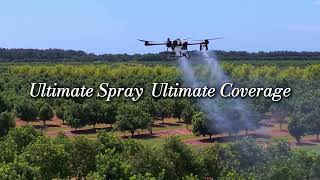
Agricultural drones are transforming aerial application. Carrying payloads of 2.5 to 18 gallons, they dispense liquid through hydraulic nozzles or rotary atomizers, utilizing the downward wash from their rotors to drive droplets deep into the crop canopy. They fly 7 to 10 feet above the crop on pre-programmed GPS routes, utilizing radar to maintain consistent height over uneven terrain and sensors to avoid trees and power lines. Because tanks empty in minutes, ground crews are required to frequently swap batteries and refill payloads. While several drone models are rated for winds up to 18 mph, manufacturers generally advise grounding them if winds exceed 22 mph.
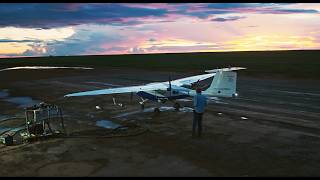
For larger scale operations, autonomous fixed-wing aircraft cover significantly more ground per pass. One electric model currently on the market carries 80 gallons, delivers a 65-foot swath, and can take off from unimproved dirt or grass strips.
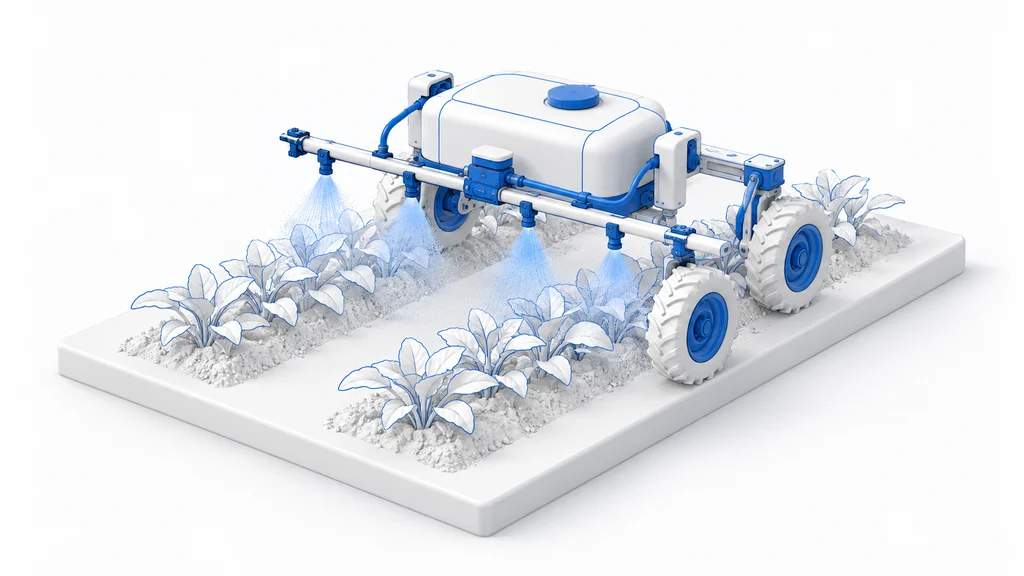
In orchards, self-driving ground sprayers navigate rows using GPS and LiDAR. A rear-mounted fan forces air through the canopy, carrying droplets deep into the foliage, while smart manifolds shut off individual nozzles when gaps in the trees are detected. A single operator can monitor up to eight of these machines from a laptop, acting as a "nurse" to refill their tanks on demand.
The most advanced machines "look" before they spray. Using computer vision, cameras identify specific plants or weeds and trigger only the nozzles directly above them, drastically reducing chemical usage. One narrow-row field robot goes a step further, bypassing chemicals entirely to treat mildew by shining ultraviolet light onto the plants.
Despite these robotic advancements, the human element remains essential. People are still required to mix chemicals, load payloads, clean tanks between different products, and program the machines—and conventional tractor-mounted sprayers still require a skilled operator at the wheel.